
Autonomy is the next great frontier for AI, but it comes with significant structural risk. At MarkX AI Labs, we define an 'Autonomous Agent' as a system capable of making decisions and executing actions across multiple software layers—such as financial accounts, database records, and communication channels—without human intervention.
To manage this, we have developed the Red-Line Protocol. This is a hard-coded neural constraint system that operates independently of the agent's primary reasoning layer.
The Three Pillars of MKX Agent Ethics:
- Verifiable Audit Trails: Every decision node in our agent architecture is logged to an immutable ledger. We use cryptographic proofs to ensure that an agent's reasoning can be reconstructed and audited after the fact.
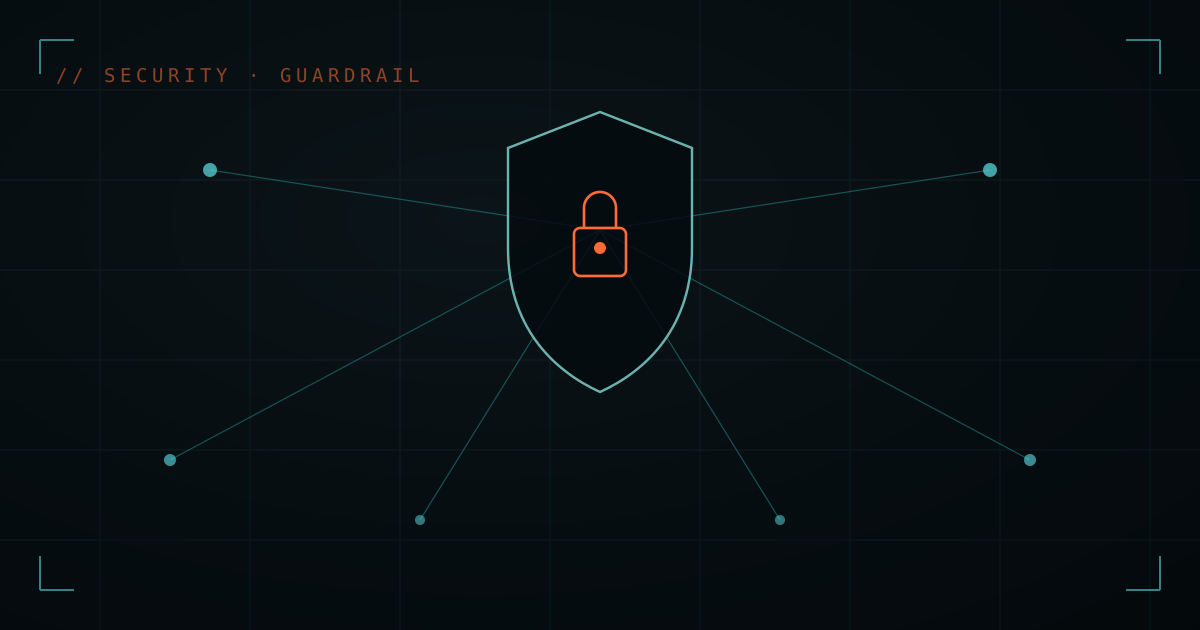
- Deterministic Guardrails: While the agent is 'creative' in its reasoning, its outputs are filtered through a set of deterministic rules. If an action falls outside of the 'Safe Zone' (e.g., attempting to transfer funds to an unverified node), the action is automatically blocked.
- Neural Scrubbing: To prevent privacy drift, our agents are designed with 'Ephemeral Memory.' They retain the context needed to complete a task, but automatically purge PII (Personally Identifiable Information) once the session ends.
By treating ethics as an engineering constraint rather than a legal afterthought, we build systems that are powerful, predictable, and profoundly safe.